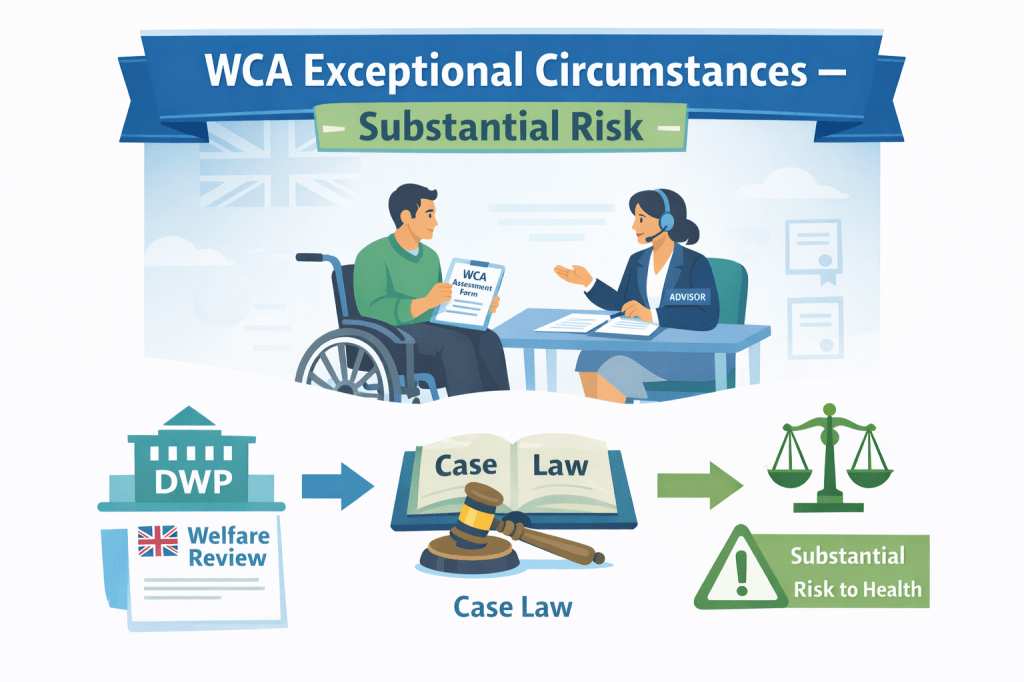
This article examines the key concessions under the exceptional circumstances/substantial risk rules for ESA and UC. It also highlights the significance of Charlton (RIB)2/09 and the IJ v SSWP (IB) decisions for implementing and interpreting those.
The UK government’s recent attempt to reform the Work Capability Assessment has sparked significant controversy, culminating in a High Court ruling that found the consultation process to be “misleading and unfair”. While the government intends to follow the previous administration’s plan to phase out the WCA, potentially allowing work coaches greater discretion in granting any relevant concessions – where applicable, disability rights campaigners, including our organisation, have raised serious concerns. It has been warned, that these changes could have severe consequences for disabled individuals who rely on these assessments to access essential support. The ruling highlights the need for a rigorous and transparent regulatory framework to ensure that policy changes do not disproportionately harm vulnerable individuals.
A particularly contentious aspect of the proposed reforms was the consultation on modifying or eliminating the Limited Capability for Work (and Work-Related Activity) Substantial Risk criteria. This provision was originally designed as a safeguard for claimants who would face significant health risks if found ineligible for LCW(RA). However, the government argued that its application had extended beyond its intended purpose. The consultation sought feedback on whether to amend or remove these protections and how affected claimants could be safely supported under a revised framework. Disability rights groups strongly opposed the proposal, warning that restricting access to this crucial safeguard could lead to serious harm.
Background
The Work Capability Assessment was introduced as part of Employment and Support Allowance that replaced Incapacity Benefit in 2008.
The WCA on ESA and subsequently on Universal Credit, is structured around the assessment of a claimant’s ability to perform 17 prescribed activities, with scores assigned based on the severity of functional limitations. The outcome of the assessment determines the level of support and conditionality applied to the claimant, including the type of work deemed suitable for them, and the assessment is based on how their circumstances match a set of predefined descriptors comparable to the criteria of the Personal Capability Assessment for Incapacity Benefit.
The WCA has faced criticism since its inception, particularly regarding the number of individuals who could not be adequately assessed using the set criteria and consequently fell through the cracks.
Rigid Criteria, Real Consequences
A key issue in WCA assessments has been the lack of flexibility in recognising the nuanced ways in which disabilities affect individuals’ ability to engage in work-related activities. Critics long argued that the descriptors fail to capture the full impact of fluctuating conditions, mental health issues, and chronic illnesses, leading to inaccurate assessments and unfair benefit decisions. The rigid classification system often places claimants in categories that do not reflect their real-world capabilities and limitations.
The Substantial Risk Rules
A claimant can be treated as having limited capability for work (LCW) after failing to score sufficient points under the WCA if, by reason of their health condition or disability, there would be a substantial risk to the health of the claimant or others were they found not to have LCW.
This is inscribed in primary legislation as Regulation 29 (and Regulation 35 for Support Group) of the ESA regulations, and the comparable Schedule 8 (and Schedule 9 for LCWRA) of the Universal Credit Regulations.
Para 4 of Schedule 8 of UC Regs reads:
4. — (1) The claimant is suffering from a specific illness, disease or disablement by reason of which there would be a substantial risk to the physical or mental health of any person were the claimant found not to have limited capability for work.
The centrality of the Substantial Risk consideration on WCA has been highlighted by Judge Ward in RB v SSWP (ESA) (2012) UKUT 431 (AAC):
[…] the more onerous the points based regime becomes, the more cases are likely to require attention to be given to the terms of regulation 29.
Whilst, Judge White who reviewed various caselaw and provided tribunals with guidance on handling substantial risk, notes in [2014] AACR 33 that;
regulation 29 (or regulation 25 for universal credit) is more likely to apply when mental, cognitive, and intellectual functions are involved. Furthermore, as legislative changes narrow the focus of descriptors, the safety net provision of regulation 29 is increasingly likely to be relevant.
As it is reasonable to infer from the above, the Substantial Risk Regulations are a highly valuable tool for decision-makers and FtTs in determining the appropriate group or claimant commitment for claimants and appellants.
Developments / Relevant Case Law
Charlton (RIB)2/09 addressed a key principle in substantial risk decisions. It established that assessing health risks at work requires evaluating the type of work suitable for the claimant. Before Charlton (RIB)2/09, assessments primarily focused on whether a claimant could perform any type of work rather than considering the suitability of work based on their specific condition. The decision reinforced that WCA assessments must account for the practical impact of work-related stressors and environmental factors on a claimant’s health.
Similarly, IJ v SSWP (IB) reported as CIB/1219/2010; [2010] UKUT 408 (AAC), clarified that the substantial risk test is not limited to the direct consequences of work but also extends to the wider implications of being found capable of work. As Judge Marks explained:
10. Further, the test is not limited to whether there would be a substantial risk to the claimant from any work he may undertake. The test is as to the risk as a result of being found capable of work. If he was found capable of work, he would lose his incapacity benefit, and would very possibly need to seek work and apply for jobseeker’s allowance. That would involve his attending interviews, and going through all the other steps that would be needed to obtain and keep jobseeker’s allowance. In the present economic climate, a claimant who is 62 years old with mental health problems, and who has not worked since the early 1990’s, is unlikely to find work quickly and would very possibly never find it. His GP’s assessment that it is inconceivable that he would ever be able to earn his living may be right. The tribunal would then have to determine how this change from his being in receipt of incapacity benefit would affect the claimant’s mental health, looking not at some work he may do, but at the effect on his mental health of fruitless and repeated interviews and the possibly hopeless pursuit of jobs until he reached retirement age. These factors were not considered by the tribunal, and indeed they did not elicit the information necessary to enable them to be considered, such as whether he had in fact applied for jobseeker’s allowance and if not, how he was coping or would cope.
This offered the important clarification that the substantial risk test can encompass the consequences of losing ESA, pursuing an appeal, claiming Jobseeker’s Allowance, attending jobcentre and employer interviews, and seeking employment. That was confirmed in [2014] UKUT 241 (AAC) which additionally further clarified that the ability to work from home is irrelevant, as Charlton emphasised, considering the journey to and from work when assessing risk.
Despite IJ having been criticised on MW v SSWP (ESA) [2015] UKUT 0665 (AAC), on which Judge Lane held;
11. It is noted that the Court of Appeal in Charlton thought it possible, although probably rare, that the very finding of capability for work might cause a significant deterioration in a claimant’s health. Apart from that rarity, the Court of Appeal states firmly that the risk to be assessed must arise as a consequence of work the claimant would be found capable of undertaking, but for regulation 29.
IJ has since been considered and confirmed in many cases, including perhaps the most recent ET v Secretary of State for Work and Pensions (UC): [2021] UKUT 47 (AAC) where Judge Wright decisively, and with conviction settled the matter; Naming MW ‘the main, if not sole contrary decision’, where he acknowledges on paragraph 26 that:
other subsequent decisions have been decided on a basis more consistent with the IJ/NS line of authority than with MW: see, for example, the ‘by reason of’ analysis in paragraph [10] of JT v SSWP (ESA) [2018] UKUT 124 (AAC).
Conclusion
The debate surrounding WCA reform underscores the ongoing tensions between cost-cutting measures and the need for a fair, transparent, and supportive welfare system. Legal precedents and case law developments highlight the crucial role of substantial risk provisions in protecting claimants from adverse health consequences. As the government moves forward with its proposed reforms, it must ensure that any changes uphold the rights and dignity of disabled individuals, preventing further marginalisation and unnecessary hardship.
Bibliography
Hooker, I. et all. (2023), Sweet and Maxwell, Social Security Legislation 2023/24 Volume I, Non Means Tested Benefits [pp.1422–1423].
Kennedy, S., Mackley, A., McInnes. R., Jap, B., O’Donnell, M., Bellis, A., Clark, A., (2018), Ten years of the work capability assessment in relation to employment support allowance and universal credit. Available at: https://commonslibrary.parliament.uk/research-briefings/cdp-2019-0092/ (Accessed: 7th January 2025)
The Employment and Support Allowance Regulations 2008, s 29. Available at: https://www.legislation.gov.uk/uksi/2008/794/regulation/29 (Accessed: 6th January 2025)
The Employment and Support Allowance Regulations 2008, s 35. Available at: https://www.legislation.gov.uk/uksi/2008/794/regulation/35 (Accessed: 6th January 2025)
UK Government. (2024) Government response to the Work Capability Assessment activities and descriptors consultation. Available at: https://www.gov.uk/government/consultations/work-capability-assessment-activities-and-descriptors/outcome/government-response-to-the-work-capability-assessment-activities-and-descriptors-consultation (Accessed: 7th January 2025).
Williams M. (2013), ‘Making an Exception’, Welfare Rights Bulletin, Issue 233 (April). Available at: https://askcpag.org.uk/content/200183/making-an-exception (Accessed: 6th January 2025).
 Civilised Citizen
Leave a comment